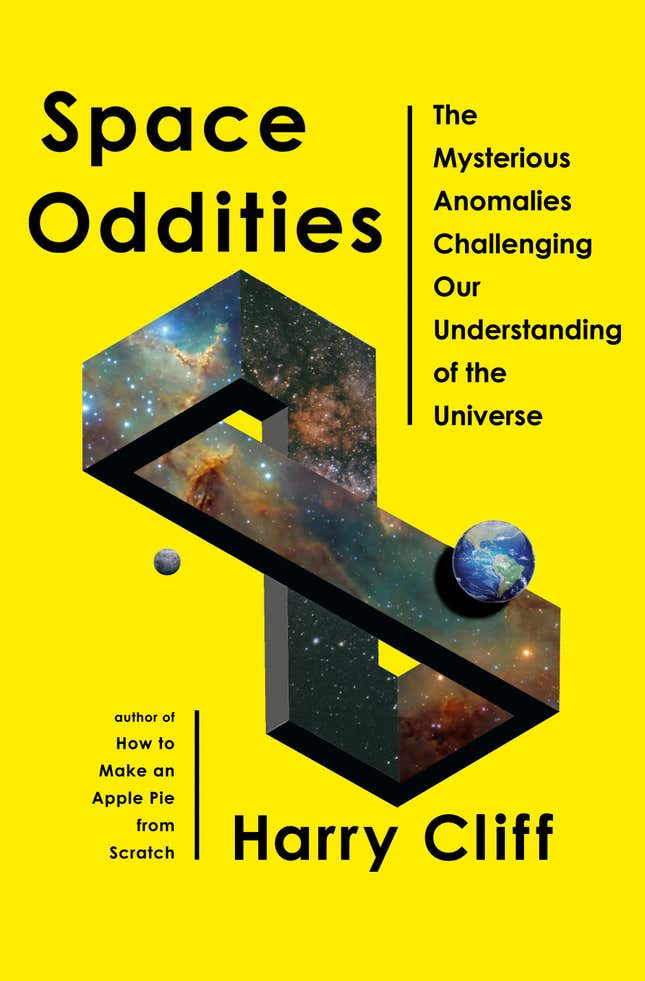
The universe is a deeply vexing place. Each breakthrough we make in our understanding of it begets extra mysteries about how all this (gestures wildly) truly occurred. Within the new guide Space Oddities: The Mysterious Anomalies Challenging Our Understanding of the Universe, experimental physicist Harry Cliff describes a handful of probably the most confounding phenomena at play in physics. Cliff charts the trail that scientists have taken to reach at our trendy understanding of the way it all works.
From lots so small they operate extra like waves to the black holes that conceal their interior workings with distinctive success, Cliff covers probably the most enigmatic phenomenon identified to people. He additionally introduces the extraordinary folks searching for to interrupt down these anomalies. Fixing even certainly one of these mysteries might unlock a brand new period of scientific understanding.
Under is my dialog with Cliff, calmly edited for readability.
Isaac Schultz, Gizmodo: This guide is your second, after How to Make an Apple Pie From Scratch. Why did you resolve to embark on this second challenge? What was lacking, both in your physique of labor or within the revealed sphere, so far as particle physics is anxious that wanted addressing?
Harry Cliff: It actually got here out of my analysis. I work on the Giant Hadron Collider. I got here in proper initially of the Giant Hadron Collider, on the finish of the primary decade of the twenty first century. And I’ve been there ever since. Mainly what occurred is we found the Higgs boson, which is nice and really thrilling, and that type of rounded off our understanding of twentieth century physics in some sense. The nice hope was there could be new discoveries of issues that we didn’t find out about earlier than, like darkish matter or supersymmetry or no matter, and none of that appeared. All these expectations had been form of not realized. However all through high-energy physics, we had been seeing these anomalies, which had been hinting on the potential existence of recent particles or new forces that we hadn’t imagined. That was actually, actually thrilling.
My very own analysis from about 2015 onwards actually centered on these anomalies. It’s an fascinating concept that individuals could also be not so acquainted with, as a result of within the historical past of physics and our understanding of nature, the largest breakthroughs usually do come from these little bizarre niggling results that you simply would possibly dismiss at first, that nobody actually understands. They become some clue to some large new shift in the way you see the world.
The guide is de facto an try and each discover what’s happening in analysis, in cosmology and our understanding of the universe in the intervening time, but additionally set this in some type of context and say, “the explanation these items are so thrilling is as a result of previously, they’ve led to those actually large breakthroughs, and take a look at the place this is likely to be taking us sooner or later.”
Gizmodo: I converse lots with people who’re on the lookout for indicators of darkish matter. It looks as if a lot of the work proper now could be simply narrowing the mass vary. It’s obtained to be on the market. Or at the least we anticipate it to be. However the excellent query is, “when will this occur?” The general public and clearly the media would love for it to be an enormous “newsflash!” expertise. However one factor that you simply contact on within the guide is that science, most of the time, doesn’t work that means.
Cliff: Often these items emerge regularly. You get your first clues, and generally it takes many years or extra to unravel these items. One of many examples within the guide is that this bizarre downside with the orbit of Mercury that was noticed within the nineteenth century, the place Mercury’s turning up too early, mainly, for transits of the Solar. That took a couple of century extra to determine what was a explanation for it.
It’s fairly uncommon in science that there’s this ‘eureka!’ second the place every little thing turns into clear. That occurs extra usually once you’re discovering one thing you anticipate to see. The Higgs boson was an instance of that. It had been predicted 50 years earlier; you construct a Giant Hadron Collider to experiment, see this new bump in a graph, however they know what it’s, as a result of they’re anticipating it. You’ll be able to say: On the 4th of July 2012, the Higgs was found. Whenever you’re actually discovering one thing new that’s outdoors your expectation, it takes lots longer, since you’ve obtained to persuade your self of what you’re seeing, you’ve obtained to persuade others of what you’re seeing. Individuals are way more prepared to simply accept issues they anticipated and way more resistant to simply accept issues they didn’t see coming.
One of many tales within the guide is about Adam Riess, the Nobel Prize-winning cosmologist. He’s been coping with this downside with the enlargement of the universe. He’s been slogging at this now for a decade, and from his viewpoint, this anomaly is like gold-plated. They’ve checked each potential impact, and it appears that evidently there actually is that this anomaly there. However as a result of there isn’t a ready-made theoretical rationalization for what’s inflicting this, the remainder of the sphere is way more skeptical. He’s obtained an actual job on his fingers of persuading his colleagues that that is the true deal.
Gizmodo: You open and shut the guide with the Hubble stress. Why? What makes that the pivot level?
Cliff: It’s partly as a result of house is simply sexier than particle physics. I feel it’s simpler for folks to have interaction with one thing that’s happening out in house, and stuff that’s happening on the subnuclear stage is a little bit bit extra summary and laborious to get your head round. It’s fairly romantic to be interested by galaxies and the enlargement the universe. I cope with 5 large anomalies within the guide. There’s 5 substantial chapters on stuff that’s happening in the intervening time.
I consider all of them, the Hubble stress is the one which I personally discover probably the most compelling, simply because it’s the one the place idea could be very clear about what ought to occur, and the experimental proof appears very robust. It’s not simply Adam Riess’ group. There are many teams. Each measurement, mainly, that has been fabricated from the enlargement of house utilizing stuff within the native universe—and by native we’re speaking, , large distances nonetheless, however galaxies and stuff which you can see—all of them mainly line up, kind of. There’s a couple of that form of wobble about, however it appears impossible at this stage, after a decade of scrutiny, that there’s some actually large mistake that has been missed. There’s one thing to be understood, for positive. Now, whether or not that’s one thing that’s really revolutionary, like a rewriting of the legal guidelines of gravity or a brand new type of vitality within the universe that we haven’t understood earlier than, possibly telling us one thing about darkish vitality. It might be one thing to do with the assumptions that we’ve got in cosmology about the concept the universe seems the identical in each course, and that the place we’re within the universe isn’t significantly particular. It’s the form of assumption that we make so as to have the ability to do cosmology. I feel that it’s the anomaly that’s in all probability telling us one thing fairly profound. The opposite 4, I feel, are way more troublesome to say what’s happening.
In case you take 100 anomalies—and anomalies come and go in physics on a regular basis—most of them will go away. It would solely be certainly one of them that truly seems to be the true clue. The rationale I picked these explicit 5 is as a result of they’re ones which have been round for fairly a very long time. We’ll study one thing essential within the strategy of unraveling these ones, however I feel they’re much less prone to flip into some large new physics discovery. Whereas I feel the Hubble stress, of any of them, goes to do it. That’s the one I’d put my cash on.
Gizmodo: How did you select the experiments that you’d spotlight and the interviews that you’d do with physicists, to liven up every of those mysteries?
Cliff: The very first little bit of the prologue is an outline of an experiment known as ANITA, which is an unimaginable experiment. It’s mainly a large radio antenna launched into the Antarctic skies on this large helium balloon. A part of the explanation for selecting that story, together with the anomaly being very fascinating, is simply the experiment is de facto cool. At the start of writing, I used to be considering, how might I get a means of wrangling a visit to Antarctica out of this? However I simply realized that was not going sensible or reasonably priced. So I needed to type of go secondhand. However a number of the main folks concerned are in London, which is the place I’m primarily based. In order that was a type of simple first win.
However I did do numerous touring to the States and different locations to see folks for the opposite anomalies. I used to be actually led extra by the anomalies themselves and fewer by the experiments. However certainly one of them is about my very own analysis and concerning the LHCb experiment at CERN. That’s an setting I do know very effectively. So I might describe that firsthand, whereas the others, say, Fermilab, I went there. One of many privileges, I suppose, of engaged on these kinds of books is you ship emails off to folks and say, “can I come to your under-mountain lair the place you do your darkish matter experiment?” And persons are very open. “Oh yeah, positive. Come alongside and we’ll present you round.”
Quite a lot of the environments that particle physics and astronomy experiments are performed are actually fairly extraordinary locations. An essential a part of getting throughout the science isn’t just the ideas and the phenomena that being studied, however these extraordinary environments the place the scientific analysis is carried out.
Gizmodo: I generally take into consideration physics in two methods, “wanting up” and “wanting down” science. Particle analysis deep underground, that might be a “wanting down” experiment. Trying on the Hubble fixed, finding out the Cepheid stars, could be wanting up. Within the guide, you say we reside in a universe of fields greater than a universe of particles, however we deal with particles as a result of they’ve mass. How did you strike a stability of the “wanting up” science and the “wanting down” science, so to talk?
Cliff: We mainly have two methods of finding out the universe. One is by, as you say, wanting up, and the opposite is by wanting in. I say, possibly not wanting down a lot, however wanting inwards. You’ll be able to glean a specific amount of data from wanting on the heavens, however the limiting issue is many of the universe is inconveniently distant and you may’t go. We’ve solely been so far as the Moon by way of human exploration. When it comes to machines, out to the perimeters of the photo voltaic system now, with Voyager. However that’s a tiny, tiny fraction of the dimensions of the universe.
It’s actually by the mixture of those two strategies that we’ve managed to make a lot progress. One of the vital revolutionary discoveries, and possibly not appreciated in these instances outdoors of astrophysics, was the invention of spectroscopy. The invention that atoms of explicit components emit these attribute wavelengths of sunshine and take in them. That was absolutely the key to unlocking a lot concerning the universe. That discovery was made through the use of components that we’ve got on Earth, after which permits us to say what the Solar is constituted of for the primary time, or what probably the most distant star is constituted of. So by bringing these two issues collectively, finally that’s how physics makes progress. They’re actually simply two other ways of wanting on the similar phenomena. And by bringing these two concepts collectively, that’s the way you get a full image.
Gizmodo: The high-luminosity Large Hadron Collider is on the horizon. Are you significantly excited for this subsequent technology LHC? What do you suppose would possibly come of this?
Cliff: It’s going to be actually fascinating. We’ve solely analyzed a tiny fraction of the information that’s finally going to be recorded by the high-luminosity LHC. In a means, this experiment has change into much more essential, as a result of what we’ve got discovered within the final decade or so is that if there may be new physics on the vitality scales that we’re probing on the LHC, it’s hiding fairly successfully. A high-precision machine the place you get, , orders of magnitude extra knowledge will enable us to eke out if there are these very uncommon occasions, uncommon processes which can be hiding within the knowledge. That’s going to be our greatest probability of seeing them.
However the different factor I feel numerous colleagues at the moment are emphasizing is what the legacy of the LHC goes to be. Even when we don’t uncover any new physics on the LHC, it’s going to go away this extraordinary legacy of the understanding the fundamental components of our universe and the legal guidelines that govern their conduct. The fundamental aim by the top of the 2030s, when this factor powers down for the final time, is that we’ll have actually stunning, exact measurements of the Normal Mannequin. That’s going to be actually essential, as a result of once we go to the following experiment, no matter which may be, it’s that type of groundwork that we’ve performed that can enable us to see when ultimately the brand new factor crops up. However in fact, we could also be fortunate, and we could get the brand new factor within the coming 12 months.
Gizmodo: You’ve a few anecdotes within the guide about Fall of Icarus-esque errors, the place complete experiments have collapsed attributable to misunderstanding of the numbers or taking the numbers from the improper locations. It connects with what you wrote about Fermilab’s muon G-2 experiment, the place it pays to double-blind your self from your individual experiments. In any other case the numbers are tantalizing in a means.
Cliff: Yeah, completely. One of many quotes that I really like that I put within the guide is from Feynman, which is that “the primary rule is it’s essential to not idiot your self, and you’re the best particular person to idiot.” Individuals are in science as a result of they need to make discoveries. The temptation to consider once you see some impact in your experiment is big, as a result of everybody needs that pleasure, that second of seeing one thing that nobody has ever seen earlier than. I feel a very powerful high quality for experimental physicists is skepticism, and actual warning. Typically even very, very cautious and skeptical folks make errors. That will not be as a result of they’ve, , massaged the information or performed something improper. It’s simply that there’s some very delicate impact that no person considered.
And that does occur. In my very own space of analysis, we had a collection of anomalies that ultimately turned out to be some very delicate backgrounds that we thought we had underneath management. However once we by probability stumbled upon some proof that these items had been truly not underneath management, we ultimately untangled this. In different circumstances, it’s idea that may go improper. Incorrect assumptions can creep in. And even generally actually fundamental, like highschool errors the place you by accident put a -1 as a substitute of a +1 or one thing. That really did occur within the muon experiment you had been referring to. There actually was an indication error in a calculation that made folks suppose they had been seeing proof of recent physics.
However then there are examples the place folks take shortcuts. That comes generally from this fierce need to be first. And when you’re in competitors with one other experiment, you need to be the one which makes the large discovery. And that’s the place the temptation to not do one thing fully rigorously can are available in, and that may be fairly disastrous when you then make some large declare that seems to not be appropriate. However that’s the wonderful thing about science. It’s self-correcting. And even when one thing will get revealed that seems to be improper, it’ll get came upon nearly at all times, ultimately.
Gizmodo: An instance of that type of scientific hubris is the Mercury-Vulcan concern the place, as you describe within the guide, this prestigious astrophysicist barges into an novice astronomer’s house, and hastily launches this inaccurate discovery. As you say, it takes a century of undoing, however it will get performed.
Cliff: That was a loopy one, as a result of the discoverer of this non-existent planet obtained, like, France’s highest honor, for locating one thing that didn’t exist.
Gizmodo: There’s that occasion and one other second you describe, the place a younger Richard Feynman could be very nervous about giving a speech in entrance of Paul Dirac.
Cliff: One of many causes for bringing within the historical past is to set the trendy experiments in context. They’re a part of an extended course of that stretches again many years usually, of experimentation, theorization. You’re type of constructing all of this accrued information after which taking the following step that possibly results in one thing thrilling.
Gizmodo: You had been doing a lot touring, talking to people in several fields of physics than your individual for the guide. What did you study that was new to you?
Cliff: I suppose the factor I actually got here away appreciating is simply the trouble that goes into, significantly, the experiments. You’ve folks dedicating many years of their life to measuring one quantity. Take the muon G-2 experiment in Fermilab for instance. Chris Polly, who’s the spokesperson of the experiment, who confirmed me round Fermilab, he’s been engaged on this one quantity his complete profession. He did his PhD on the primary model of the experiment. His colleagues led the event of this new model, which concerned this large logistics challenge of transferring this magnetic ring from New York to Chicago through the Atlantic and the Mississippi River, after which years and years and years of painstaking work, understanding each little little bit of the experiment, measuring the magnetic fields to loopy precision, controlling the setting throughout the warehouse. And it’s solely in any case of this unimaginable care that lastly, on the finish of that course of, you get a quantity. And that’s the factor you’re aiming for. I’ve obtained large admiration for folks like that who’re prepared to undergo many years of slog to truly add a little bit bit of recent information to the financial institution of our understanding about nature.
Gizmodo: Are you able to inform me a bit about your work on the LHCb experiment?
Cliff: LHCb is without doubt one of the 4 large experiments on the Giant Hadron Collider, this 27 kilometer ring the place we collide particles. The B stands for magnificence, which is the title of one of many six quarks in nature, additionally extra often often called a backside quark. However we’d reasonably be often called magnificence physicists than backside physicists. Mainly, when it was found, there was this type of toss-up about what it was going to be known as. Most individuals name it backside; we name it magnificence.
The rationale these items are fascinating is that the best way they behave, the best way they decay, could be very delicate to the existence of recent forces or new particles that we’ve not seen earlier than. So these are an important laboratory for looking for oblique proof of one thing that we’ve not seen earlier than. It’s a praise to the opposite experiments on the LHC, the place you bash stuff collectively and also you try to create new particles. So that you would possibly search for a Higgs boson or darkish matter or no matter. At LHCb it’s a distinct recreation, of precision, of measurement, and basically making an attempt to eke out one other decimal place the place you would possibly begin to see a deviation. That’s the type of physics that we do. I’ve been on LHCb for the reason that begin of my physics profession now. So, since 2008, and we’re nonetheless going robust. We’ve simply had an enormous improve, and the experiment is taking knowledge at an growing charge. So we’re hopefully going to get extra details about these anomalies within the subsequent 12 months or two. It’s an thrilling time.
Gizmodo: What was it like writing the guide alongside the work you had been doing on the LHC?
Cliff: After I began writing the guide, the anomalies that we had been seeing on the Giant Hadron Collider had been wanting actually, actually compelling and thrilling, and there have been fairly a couple of outcomes that got here out that obtained numerous media consideration. There was this actual sense that we had been on the point of one thing very thrilling. After which, as I used to be writing the guide on the similar time, we had been realizing that there was one thing that we’d missed. So it was type of a salutary expertise as a scientist, going by that strategy of considering you’re on the point of one thing after which realizing—to your horror—that there’s a bug, basically, in evaluation. I didn’t need to shrink back from that within the guide.
I wished to offer a way of what science is definitely like. And once you’re working on the limits of understanding, you’re actually taking dangers. You might be in actual hazard of constructing errors since you don’t know what you’re doing. You’re doing the most effective you’ll be able to, however you’re on unexplored terrain, and there’s a really excessive threat of constructing errors. My skepticism, in all probability my youthful enthusiasm, could have given strategy to a barely extra middle-age skepticism on account of this entire expertise, which I hope will make me a greater scientist in the long term.
Trending Merchandise