The supermassive black gap on the middle of our galaxy is the undisputed heavyweight champion of the Milky Means, however a newly noticed object takes the crown for essentially the most large stellar black gap identified in our galaxy, weighing in at a powerful 33 instances the mass of our Solar.
A group led by Pasquale Panuzzo, an astronomer on the Observatoire de Paris, has uncovered essentially the most large stellar black gap ever detected within the Milky Means. Gaia BH3 dwarfs the earlier file holder, Cygnus X-1, which weighs simply 21 photo voltaic plenty. The findings are detailed in a paper launched at this time within the journal Astronomy and Astrophysics.
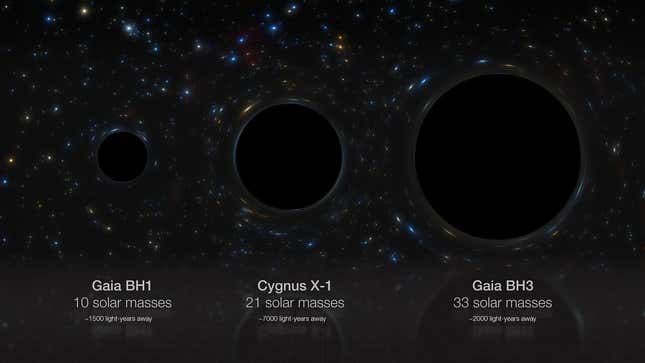
Gaia BH3 is within the constellation Aquila, roughly 2,000 light-years from Earth. The group found it throughout a assessment of knowledge from the European Area Company’s Gaia mission, a space-based observatory that has been operational since 2013. Gaia’s ongoing mission is to assemble essentially the most detailed three-dimensional map of our galaxy. The star orbiting BH3 was already identified to astronomers, however its standing because the companion of a black gap got here as an entire shock, and the ensuing weight much more so.
“Once I noticed the outcomes for the primary time, I used to be satisfied there was an issue within the information. I couldn’t imagine it,” Panuzzo instructed Gizmodo. “Now, I really feel I’ve actually accomplished the discovery of my life!”
The invention was backed by a collection of ground-based observatories and complicated devices, together with the Ultraviolet and Visible Echelle Spectrograph (UVES) on the European Southern Observatory’s Very Giant Telescope in Chile, the HERMES spectrograph on the Mercator Telescope in Spain, and the SOPHIE high-precision spectrograph in France.
The astronomers used Gaia’s exact measurements to find out the dimensions of the orbit and the time it takes for the star to circle across the black gap. They then utilized Kepler’s legal guidelines, that are ideas that describe the motions of planets and stars, to calculate the black gap’s mass from the orbit’s measurement and interval. They employed two strategies: astrometric measurements, which observe the slight wobbling actions of the companion star because it seems to shift positions within the sky, and spectroscopy, which makes use of the Doppler impact to measure the pace at which the star is transferring towards or away from us.
Stellar black holes are remnants of large stars that collapsed beneath their very own gravity, usually forming black holes about 10 instances the mass of our Solar. Gaia BH3’s vital mass suggests it originated from a metal-poor star, which retained extra mass over its lifetime and will thus kind a bigger black gap upon its loss of life, in line with the brand new analysis.
In contrast, supermassive black gap Sagittarius A*, parked on the galactic core, is vastly bigger, with about 4 million instances the mass of the Solar. These behemoths don’t kind from the collapse of a single star however possible develop from the merger of smaller black holes and the buildup of fuel and stellar materials over hundreds of thousands of years.
The stellar black gap “shaped by the gravitational collapse of an enormous star—a star most likely 40 to 50 instances extra large than our Solar—on the finish of its life,” Panuzzo defined. “These sorts of stars have a brief life, a number of million years, in comparison with the ten billion years of the Solar, they usually finish their life with a supernova, abandoning a black gap. Because of this we name them ‘stellar’ black holes, to not confuse them with the supermassive black holes on the middle of the galaxies.”
Panuzzo mentioned it’s “fairly possible” that even bigger stellar black holes exist in our galaxy. Beforehand, the LIGO-Virgo-KAGRA gravitational telescopes detected the merging of black holes of greater than 80 photo voltaic plenty in distant galaxies. Certainly, heavy stellar black holes have been detected earlier than, however in different galaxies and utilizing different strategies of detection. These faraway black holes are recognized by gravitational wave astronomy, which observes the ripples in spacetime brought on by the mergers of stellar black holes. I requested Panuzzo why we’ve been capable of finding big stellar black holes in galaxies far, distant, however solely just lately noticed one in our personal galaxy.
“There are two causes,” he mentioned. “The primary is that the LIGO-Virgo-KAGRA gravitational telescopes are in a position to detect black gap mergers very distant, probing billions of galaxies. The second is that these black holes are produced by large stars which have a low metallicity,” that’s, stars composed virtually completely of hydrogen and helium, with solely traces of the opposite components. “These stars have been current in our galaxy solely in its infancy, so we can’t see the formation of recent large black holes in our galaxy anymore,” in line with Panuzzo.
The information used within the research have been initially meant for the subsequent Gaia information launch, anticipated by the tip of 2025. Because of the significance of the invention, nonetheless, the group opted to publish the findings early. “This discovery has a whole lot of implications for the stellar evolution fashions and the gravitational waves area,” Panuzzo defined. “It was thought of that this distinctive discovery couldn’t be saved hidden to the neighborhood for 2 years ready for the subsequent launch.” What’s extra, by disclosing it now, the scientific neighborhood can carry out follow-up observations earlier, he added.
To that finish, future observations with the GRAVITY instrument on the ESO’s Very Giant Telescope Interferometer will purpose to find out if this black gap is pulling in matter from its environment, providing deeper insights into its nature and conduct.
Extra: Ripples in Spacetime Reveal Mystery Object Colliding With a Star’s Corpse.
Trending Merchandise