A staff of physicists and engineers at Princeton College constructed a twisting fusion reactor often known as a stellarator that makes use of everlasting magnets, showcasing a probably cost-effective method of constructing the highly effective machines. Their experiment, known as MUSE, depends on 3D-printed and off-the-shelf components.
Nuclear fusion, the response that powers stars like our Solar, produces big quantities of vitality by merging atoms (to not be confused with nuclear fission, which produces much less vitality by splitting atoms). Nuclear fission is the response on the core of contemporary nuclear reactors that energy electrical grids; scientists have but to crack the code on nuclear fusion as an vitality supply. Even as soon as that long-sought purpose is reached, scaling the expertise and making it commercially viable is its own beast.
Stellarators are cruller-shaped gadgets that include high-temperature plasmas, which might mattress tuned to foster the situations for fusion reactions. They’re just like tokamaks, doughnut-shaped devices that run fusion reactions. Tokamaks rely on solenoids, that are magnets that carry electrical present. MUSE is totally different.
“Utilizing everlasting magnets is a totally new approach to design stellarators,” said Tony Qian, a physicist at Princeton College and lead writer of two papers revealed within the Journal of Plasma Physics and Nuclear Fusion that describe the design of the MUSE experiment. “This method permits us to check new plasma confinement concepts shortly and construct new gadgets simply.”
Everlasting magnets don’t want electrical present to generate their magnet fields and will be bought off-the-shelf. The MUSE experiment caught such magnets onto a 3-D printed shell.
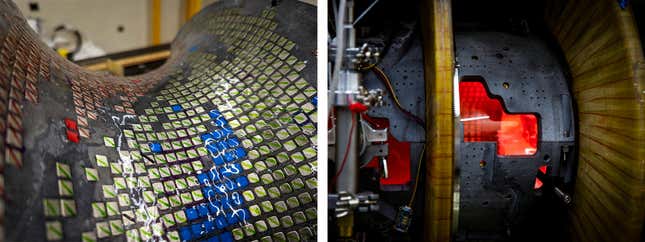
“I spotted that even when they have been located alongside different magnets, rare-earth everlasting magnets might generate and preserve the magnetic fields essential to confine the plasma so fusion reactions can happen,” Michael Zarnstorff, a analysis scientist on the college’s Plasma Physics Laboratory and principal investigator of the MUSE undertaking, in a press launch. “That’s the property that makes this method work.”
Final yr, scientists on the Division of Power’s Lawrence Livermore Nationwide Laboratory (LLNL) achieved breakeven in a fusion reaction; that’s, the reaction produced more energy than it took to power it. Nonetheless, that accolade neglects to account for the “wall energy” essential to induce the response. In different phrases, there’s nonetheless a protracted, lengthy highway forward.
The LLNL breakthrough was carried out by shining highly effective lasers at a pellet of atoms, a distinct course of than the plasma-based fusion reactions that happen in tokamaks and stellarators. Little tweaks to the gadgets, just like the implementation of everlasting magnets in MUSE or an upgraded tungsten diverter in the KSTAR tokamak, make it simpler for scientists to copy the experimental setups and carry out experiments at excessive temperatures for longer.
Taken collectively, these improvements will permit scientists to do extra with the plasmas at their fingertips, and possibly—simply possibly—attain the vaunted purpose of usable and scalable fusion vitality.
Trending Merchandise